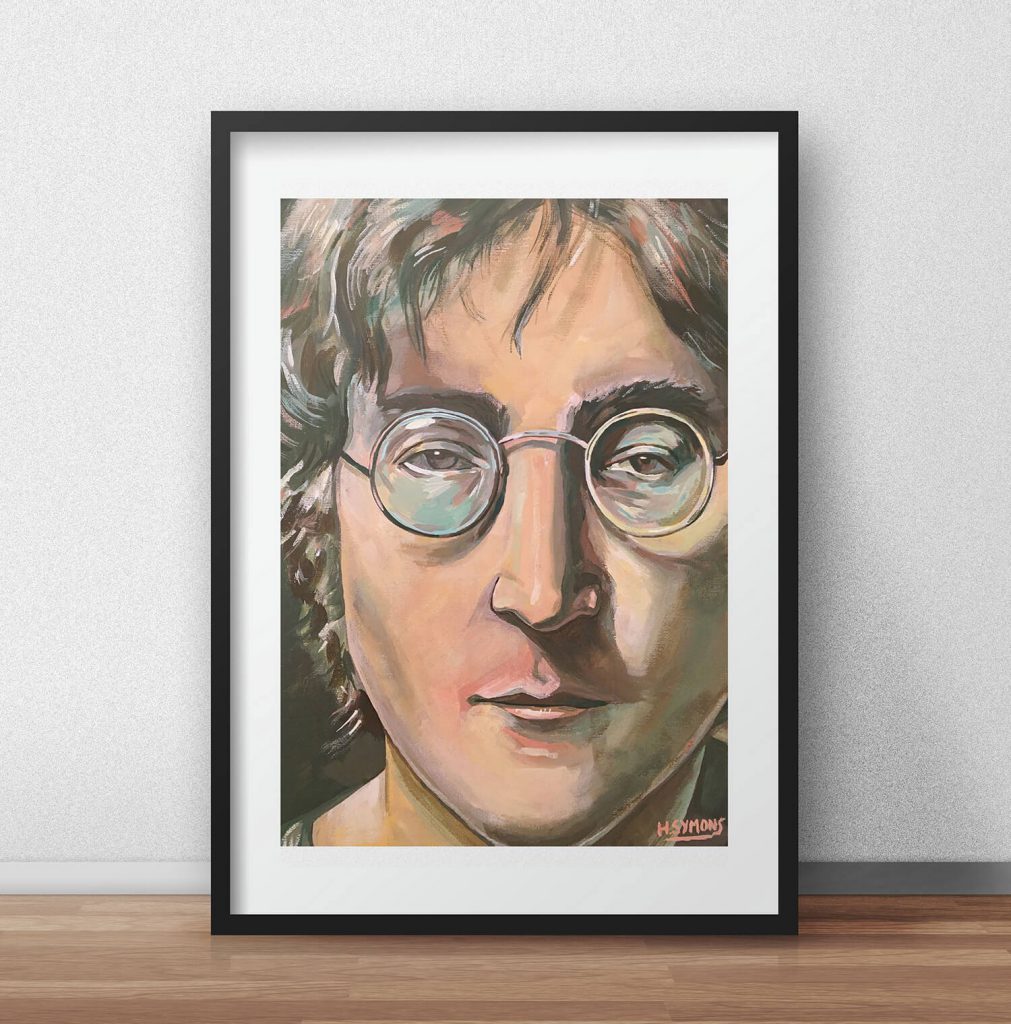
Do you have problems with shading?
Feel like your drawings could be more realistic?
It’s probably not your line-work that’s holding you back. Most of the time when rendering and shading, it comes down to how well you understand value.
Value is what gives your drawing structure, depth, and clarity. Too often beginners make the mistake of using too many values, without understanding that less is often, more.
In this article, I’ll walk you through a great value study drawing exercise (one of my favourite effective exercises you can do as a beginner), simplifying a complex photo into just five values.
It might sound simple, but this one practice can genuinely change the way you see and draw.
Why Limit to 5 Values?
Instead of trying to capture every subtle shift in tone you see in an image or from observation, we reduce everything down into five clear groups.
These are your highlights, light grey, mid-tones, a dark grey, and your darkest dark.

By limiting yourself to just five values, you remove the noise and focus only on what really matters – the big relationships between light and shadow.
This is what makes a drawing read clearly from a distance, and it’s something a lot of beginners overlook because they jump straight into detail too early.
What Makes for a Good Image to Study
When it comes to choosing a reference photo, you want to make your life easier, not harder.
Look for an image with strong, clear lighting – something where the light is coming from one direction and creating obvious shadow shapes.
Creating a portrait study is perfect for this, especially ones with side lighting, but a simple still life or even a landscape with strong sunlight can work just as well. If your image is in colour, convert it to black and white before you start.
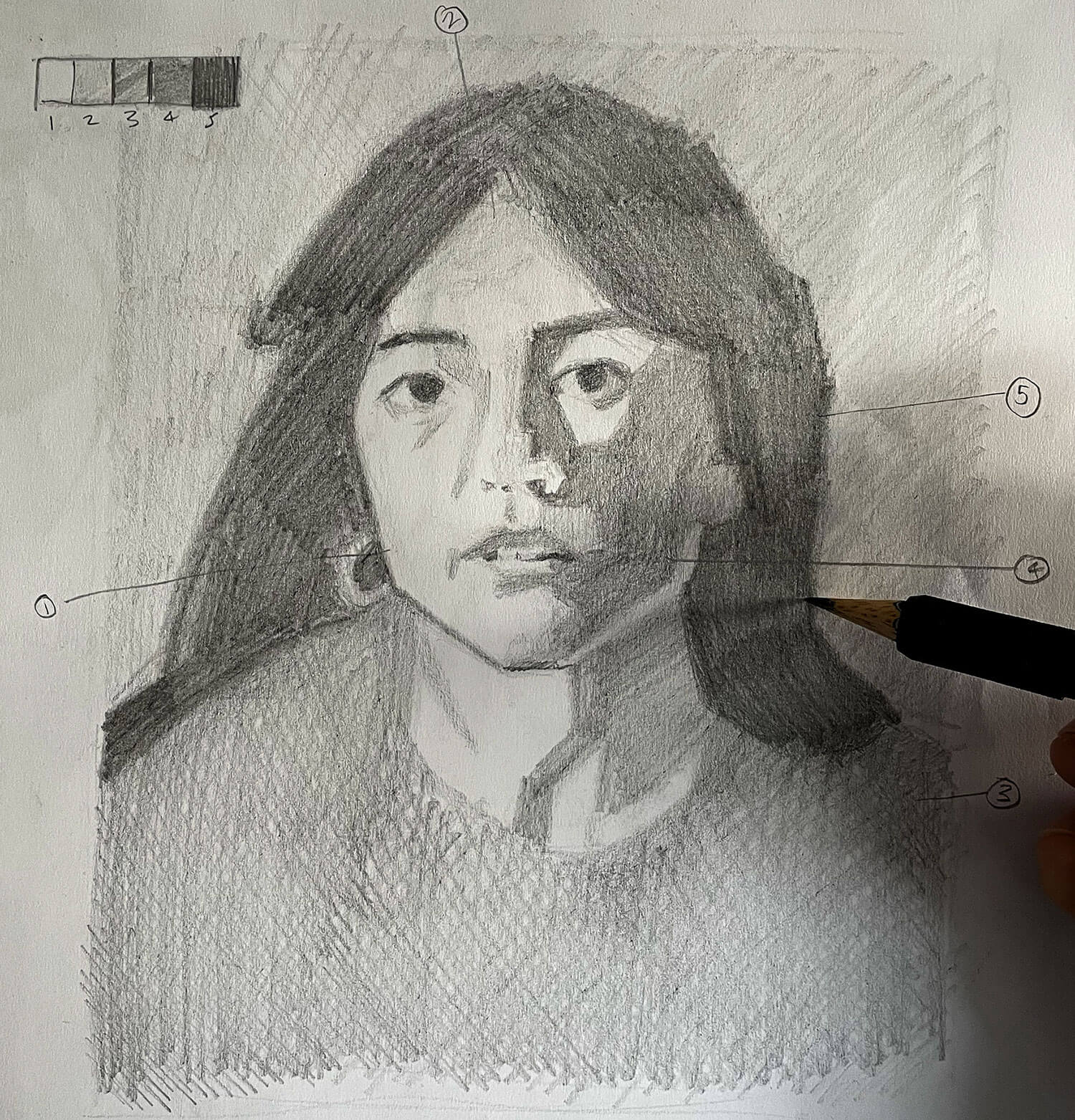
This step alone will make a huge difference, because it removes the distraction of colour and allows you to focus entirely on value.
The Drawing Exercise
Before you even put pencil to paper, take a moment to properly observe the image. This is a step that’s often rushed, but it’s where a lot of the improvement actually happens.
Ask yourself where the darkest areas are, where the lightest areas are, and try to identify the biggest shadow shapes.

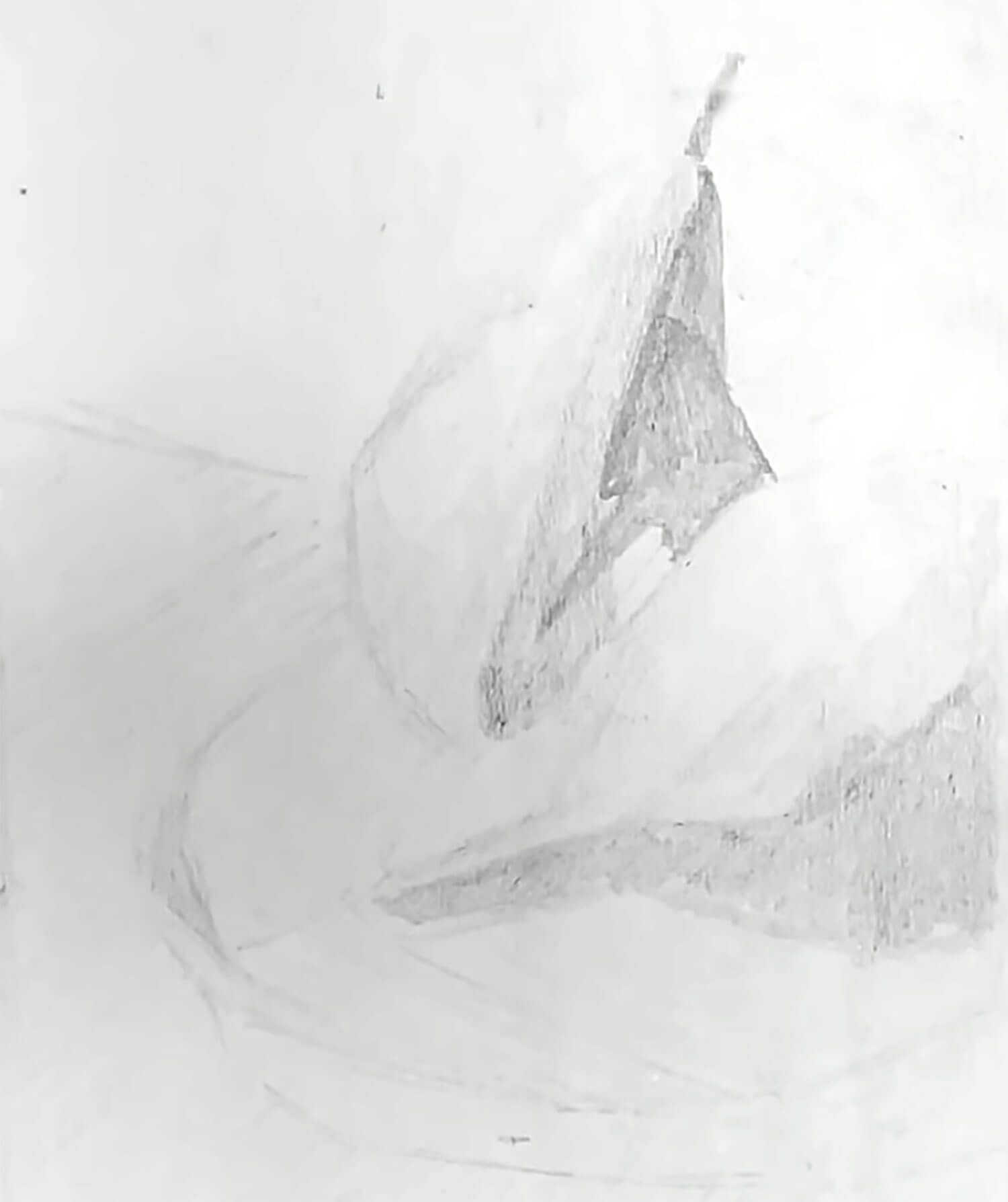
Think in terms of simple blocks rather than details.
You’re not trying to copy everything you see — you’re trying to understand how the image is built.
When you start drawing, begin by mapping in the largest shapes using a mid tone.
Avoid outlining everything. Instead, think in terms of filling in shapes, almost like you’re cutting the image into flat pieces. Keep it loose and don’t worry about accuracy at this stage.

The goal here is just to get something down that represents the overall structure of the image.
Once that’s in place, you can start assigning your five values more deliberately. Look at each area and decide where it sits — is it light, mid, or dark?
Try to make clear decisions and commit to them.
Common Mistakes to Avoid
One of the most common mistakes is staying in that safe middle ground, where everything is a similar grey.
That’s what leads to muddy drawings with no contrast.
This exercise forces you to be decisive, and that’s exactly what makes it so effective.

As you build up your values, start introducing your darkest darks. Use them carefully and intentionally, because these areas will act as anchors in your drawing.
They create contrast and help everything else stand out.
After that, bring in your lightest lights, making sure you preserve those brighter areas rather than over-shading them.
Building Up Your Tones
You’ll notice that even without any detail, the image will start to feel more complete and readable.
That’s the power of getting your values right.
Another important part of this process is learning to group shapes together. If two areas are similar in value, simplify them into one shape rather than separating them.

This is where you move from copying into interpreting. You’re deciding what matters and what can be left out, which is a huge step forward in developing your drawing skills.
At some point, you might feel the urge to start adding details — refining edges, adding texture, or tightening things up. Try to resist that.
The Goal of This Value Study Drawing Exercise
The goal of this exercise isn’t to create a polished drawing, it’s to train your eye.
By staying within the limitation of five values, you’re building a stronger foundation that will make detailed work much easier later on.
Once you’ve filled in your five values, take a step back and look at your drawing from a distance. This is a really useful way to check if it’s working.
Ask yourself if the image still reads clearly.
Can you recognise the subject without any fine detail?
If the answer is yes, then you’ve done it right. If not, it usually means your values are too close together or your shadow shapes aren’t clear enough, and that’s completely fine.
That’s the kind of feedback that helps you improve.
The real benefit of this value study drawing exercise comes from repetition. If you can spend just ten minutes a day doing this with different reference images, you’ll start to notice a shift in how you see.
You’ll become more aware of light and shadow in everyday life, and you’ll naturally begin simplifying what you observe.
Benefits of This Drawing Exercise
Over time, your drawings will start to feel more solid, more confident, and more intentional, because you’re no longer guessing — you’re making informed decisions.
This is one of those exercises that seems almost too simple at first, but it builds a skill that underpins everything in drawing and painting.
If you’ve been struggling with shading, realism, or just getting your work to look right, give this a proper go.
Keep it simple, stick to five values, and stay consistent with it.
It won’t take long before you start seeing real improvement, not just in this exercise, but in all of your work.
Many thanks for listening and visiting my blog today. You can follow what I’m up to on my Twitter, Facebook, or Instagram pages, I’ll really appreciate it if you do, and don’t be afraid to say hi to me! Many thanks again, and have a great day!

 26th March 2026